bss-cli
v1.7.0How the nine services and two portals fit together — cockpit, write-through policy, and end-to-end traces.
The operator cockpit (REPL canonical)

bss REPL is the cockpit. Type natural language; the agent calls tools; results render as ASCII cards. Slash commands (/ports, /360, /focus, /confirm) cover deterministic operator flows. v0.20 adds knowledge.search / knowledge.get so the cockpit can answer how-to questions from the indexed handbook + runbooks with cited anchors.
Since v0.13 the REPL is the canonical conversational cockpit. The browser
surface on port 9002 shares the same Postgres-backed Conversation store —
exit bss, open the page, see the same turns — and since v1.6 it carries a
full operator CRM around that chat: customer 360s, a case workbench, order
and catalog screens, subscription lifecycle — direct policy-gated CRUD with a two-step
confirm panel on every destructive or money-moving verb (see
Portals). No login wall: the cockpit is
single-operator-by-design behind a secure perimeter, with audit attribution coming from
.bss-cli/settings.toml. On the conversational path, destructive actions propose
first and wait for /confirm.
This is what "LLM-native" actually feels like in practice. The agent is not a separate surface grafted
on top of the system — it goes through the same HTTP endpoints, the same typed tool signatures, the
same write-through policy layer, and the same audit trail a human CLI user does. The only difference is
the front door: a conversation instead of a verb. When the agent tries to do something illegal, the
policy layer hands back a structured PolicyViolation with a rule code and
machine-readable context, and the agent self-corrects from that.
v1.5 unlocks multi-step orchestration — compound questions
("investigate CASE-…", "register CUST + create order", "show customer and their
subscriptions") chain in one operator turn. A new
BSS_REPL_LLM_AUTONOMY env var (granular default /
batched opt-in) controls how many /confirms a compound
destructive action needs: granular re-gates after each destructive, batched authorises
the whole loop on the first /confirm. The destructive-tools list is
unchanged — autonomy controls how many /confirms, not
which tools require one. Two safety rails sit alongside: a 3-strike loop bail
catches LLM thrash on repeated tool failures, and a cockpit chrome filter strips
banner-shape and narrated-call mimicry from both history rehydration and live emits so
the bubble the operator reads matches the action that actually ran. Pre-v1.5
propose-and-execute bubbles both said "Done." — one of them was lying; v1.5
replaces them with "Proposed X(args). Type /confirm to authorise." and
"Executed X(args)." respectively.
Architecture
Every BSS write goes through the per-service policy layer. Three trigger paths feed it:
direct via bss-clients — every CLI/REPL command, the
entire signup funnel, every post-login self-serve route, and every read; sub-second,
deterministic, no LLM. Orchestrator-mediated via astream_once
— the customer-portal chat surface (the only orchestrator-mediated route post-v0.11),
wrapping a LangGraph ReAct agent over the same tool registry. In-process tick loops
— the v0.18 renewal worker fires automatic renewals and sends upcoming-renewal reminder
emails on a 60-second tick; FOR UPDATE SKIP LOCKED makes it multi-replica safe by
construction.
Inside, two planes connect the services: synchronous HTTP over the typed
bss-clients layer (TMF APIs, named BSS_*_API_TOKEN) for calls that
need an immediate answer, and asynchronous events over a RabbitMQ topic
exchange bss.events for reactions. Every service writes directly to its own
schema in one shared PostgreSQL 16; audit.domain_event is written in the
same transaction as the domain write, with the RabbitMQ publish happening after commit
(simplified outbox). Every service exports OpenTelemetry spans to Jaeger;
bss trace renders the same spans as an ASCII swimlane in the terminal.
The audit log gets a coherent attribution on every write: actor,
channel (portal-self-serve / portal-csr /
portal-chat / cli / system:renewal_worker), and
service_identity (named-token perimeter, v0.9).
┌──────────────────┐  ┌──────────────────┐  ┌──────────────────────────┐
│ Self-serve UI    │  │ Operator cockpit │  │  bss (CLI + REPL)        │
│ port 9001 (v0.4) │  │ port 9002 (v0.13)│  │  + LangGraph orchestrator│
│   signup · chat  │  │  browser veneer  │  │   canonical cockpit      │
└────────┬─────────┘  └─────────┬────────┘  └────────────┬─────────────┘
         │                      │                        │
┌────────┴────────┐             │                        │
│ direct          │             │  shared cockpit.session│
│  bss-clients    │             │  Conversation store    │
│ (signup, post-  │             │  (Postgres-backed)     │
│  login, reads)  │             │                        │
│                 │             │                        │
│ chat → astream  │             │                        │
│ (customer_self_ │             │                        │
│  serve profile) │             │                        │
└────────┬────────┘             │                        │
         │                      ▼                        ▼
         │      ┌──────────────────────────────────────────────────┐
         │      │  bss_orchestrator.session.astream_once(channel,  │
         │      │   actor=…, service_identity=…) · ReAct agent ·   │
         │      │   allow_destructive gated by /confirm            │
         │      └──────────────────────────┬───────────────────────┘
         │                                 │
         └────────────────────►────────────┴──────────────────────►
                                  │ HTTP (TMF APIs) + bss-clients
   ┌──────┬────────┬──────────────┼───────┬────────┐
   ▼      ▼        ▼              ▼       ▼
┌─────┐┌─────┐ ┌─────┐         ┌─────┐┌─────┐
│CRM* ││Pay  │ │Cat  │         │COM  ││Subs │
│8002 ││8003 │ │8001 │         │8004 ││8006 │
└──┬──┘└──┬──┘ └──┬──┘         └──┬──┘└──┬──┘
   │      │       │               │      │   ↑
   │      └─ HTTP (e.g. Pay→CRM "customer exists?")
   │                              │      │
   │      ┌───────────────────────┼──────┘
   │      │       ┌─────┐ ┌─────┐ ┌─────┐ ┌──────┐
   │      │       │SOM  │ │Med  │ │Rate │ │Prov  │
   │      │       │8005 │ │8007 │ │8008 │ │ Sim  │
   │      │       └──┬──┘ └──┬──┘ └──┬──┘ │ 8010 │
   │      │          │       │       │   └──┬───┘
   ▼      ▼          ▼       ▼       ▼      ▼
═══════════════════════════════════════════════════════════
║         RabbitMQ — topic exchange: bss.events            ║
║  order.* · service_order.* · service.* · provisioning.*  ║
║  subscription.* · usage.* · crm.* · payment.* · port_*   ║
═══════════════════════════════════════════════════════════

In-process tick loop (v0.18): subscription service runs a
60s renewal-sweep + reminder-email worker in lifespan; FOR
UPDATE SKIP LOCKED keeps it safe across replicas.

External providers (v0.14 → v0.16):
  Resend  ─ transactional email (magic link, OTP, renewal)
  Didit   ─ KYC: hosted UI + signed-webhook corroboration
  Stripe  ─ Checkout + webhook reconciliation (PCI SAQ A)

External sibling adapter (v1.1, OPTIONAL):
  loyalty-cli ─ promo entitlements. Bearer-auth HTTP at
                loyalty-http:8080; catalog + com + crm hold the client.
                Unset BSS_LOYALTY_API_TOKEN → promo subsystem off,
                every core flow unchanged (graceful degradation).

Cockpit knowledge tool (v0.20+):
  knowledge.search / knowledge.get over the indexed doc corpus
  (HANDBOOK + CLAUDE + runbooks). Tier-0 Postgres FTS by default;
  Tier-1 pgvector hybrid behind BSS_KNOWLEDGE_BACKEND=hybrid.
  Operator-cockpit profile only; never customer chat.

┌────────────────────────────────────────────────┐  ┌──────────────┐
│   PostgreSQL 16 + pgvector (single instance)   │  │   Jaeger     │
│                                                │  │  (v0.2+)     │
│  crm · catalog · inventory · payment ·         │  │  OTLP/HTTP   │
│  order_mgmt · service_inventory · provisioning │  │  → traces UI │
│  subscription · mediation · billing · cockpit ·│  └──────────────┘
│  audit · integrations · portal_auth ·          │
│  knowledge (v0.20+ doc-corpus RAG)             │
└────────────────────────────────────────────────┘

* CRM hosts the Inventory sub-domain (MSISDN + eSIM pools) on port 8002
  under /inventory-api/v1/...; not a separate container in v0.x.
Trace anything end-to-end
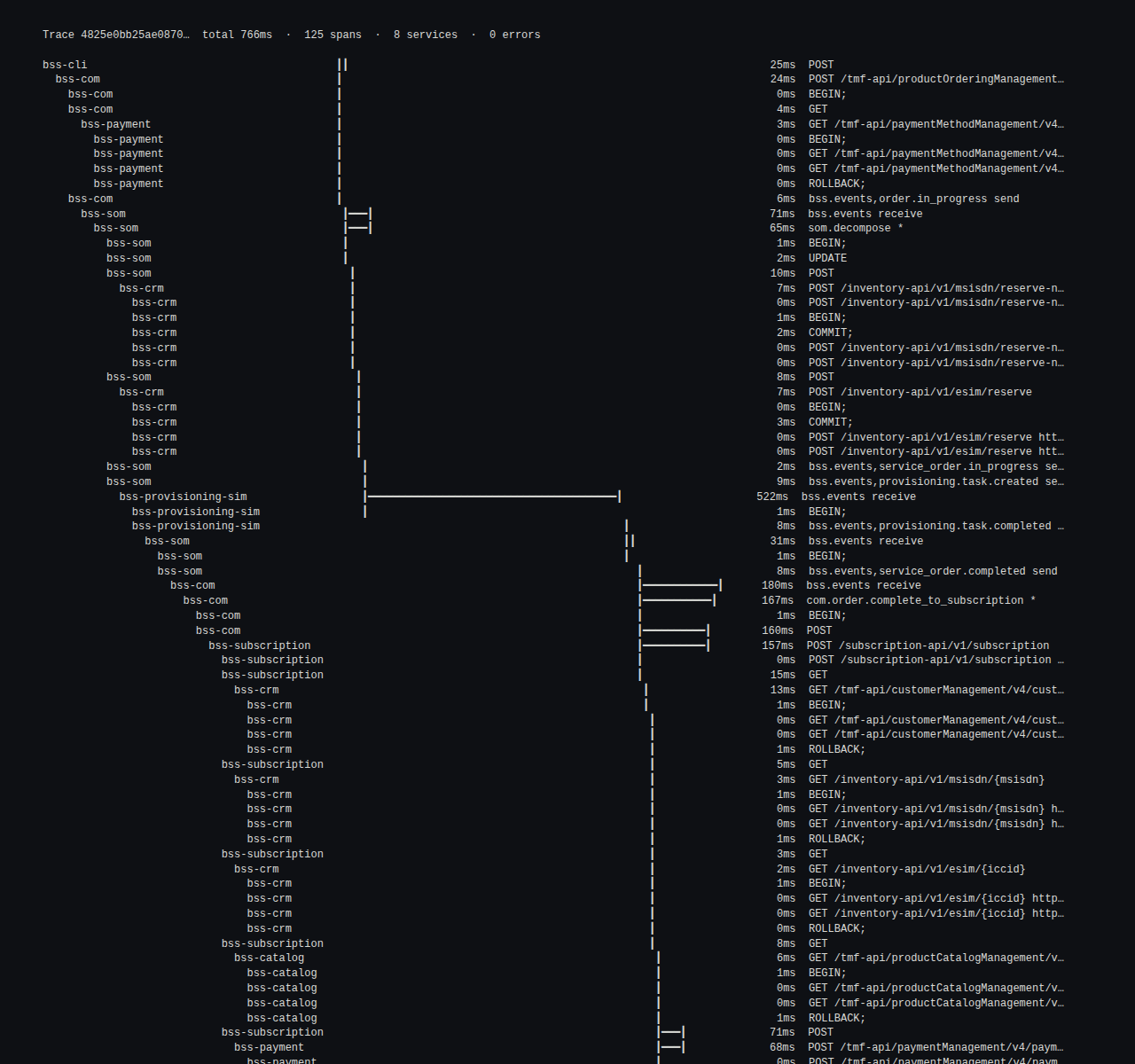
bss trace for-order ORD-… — the swimlane, rendered in the terminal.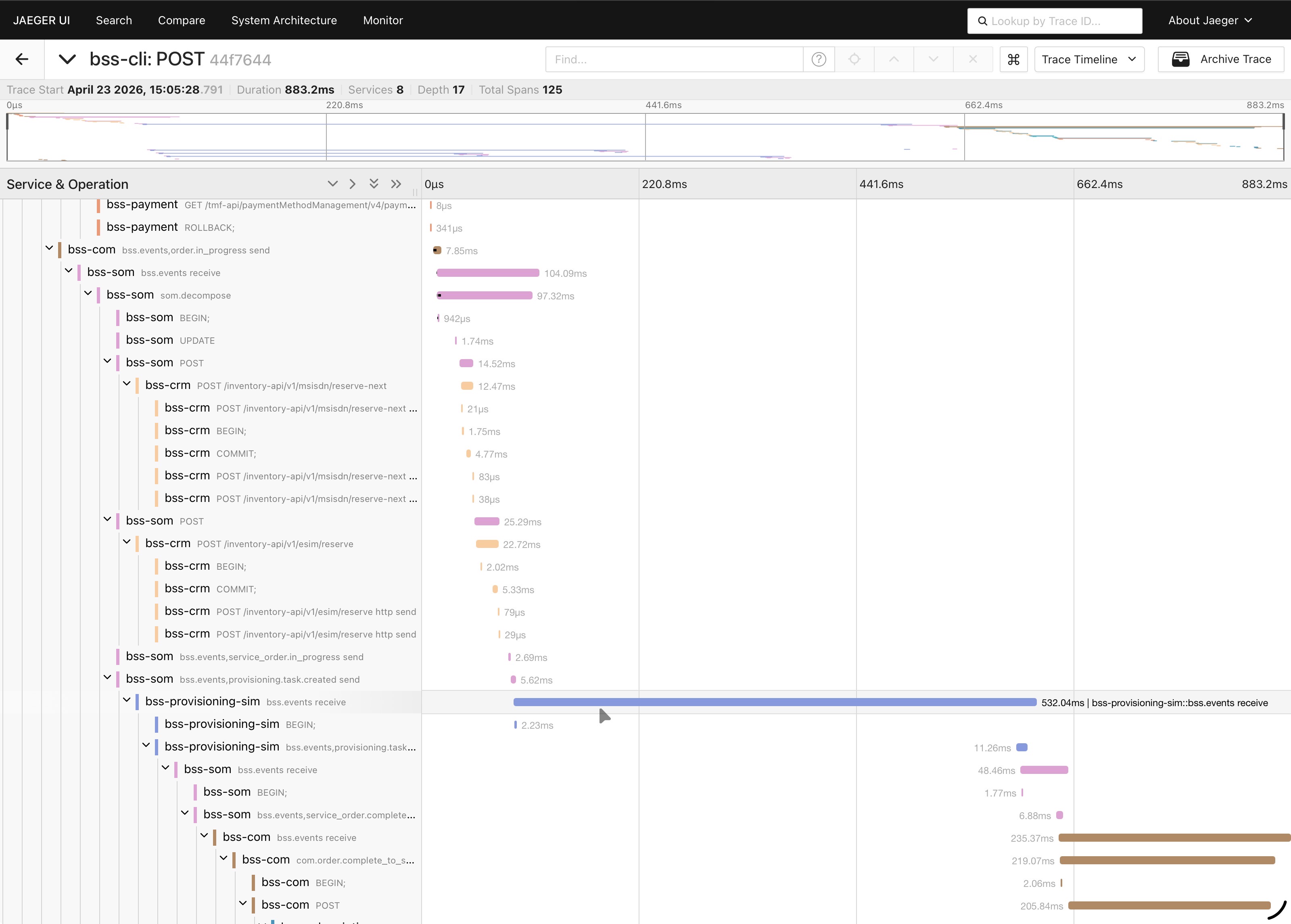
Same trace, two surfaces — bss trace for the terminal, Jaeger UI for when you want to
drill down.
OpenTelemetry is the source of truth. The ASCII view is a terminal-native lens on the same spans, not a parallel tracing system; no second pipeline to maintain, nothing to drift. If something is happening in the real traces, it is happening in the swimlane — and if you need timing breakdowns, span tags, or log correlation, Jaeger is right there.
trace 4825e0bb25ae0870  766ms  125 spans  8 services  0 errors

POST /tmf-api/productOrderingManagement/v4/productOrder              [com         ]  ████████████████████████  766ms
  └─ POST /tmf-api/customerManagement/v4/customer/CUST-022           [crm         ]    ██                        18ms
  └─ POST /tmf-api/paymentMethod/v1/charge                           [payment     ]      ████                    34ms
  └─ POST /tmf-api/serviceOrderingManagement/v4/serviceOrder         [som         ]        ████████████████      512ms
        └─ INSERT INTO service_inventory.cfs                         [postgres    ]          ▌                    2ms
        └─ POST /tmf-api/resourceInventoryManagement/v4/resource     [inventory   ]          ███                  31ms
        └─ POST /provisioning/task                                   [provisioning]              ████████████     381ms
              └─ AMQP publish bss.events provisioning.task.completed [rabbitmq    ]                          ▌    3ms
        └─ POST /tmf-api/subscription/v1/activate                    [subscription]                          ███  47ms
  └─ AMQP publish bss.events order.completed                         [rabbitmq    ]                            ▌  3ms